
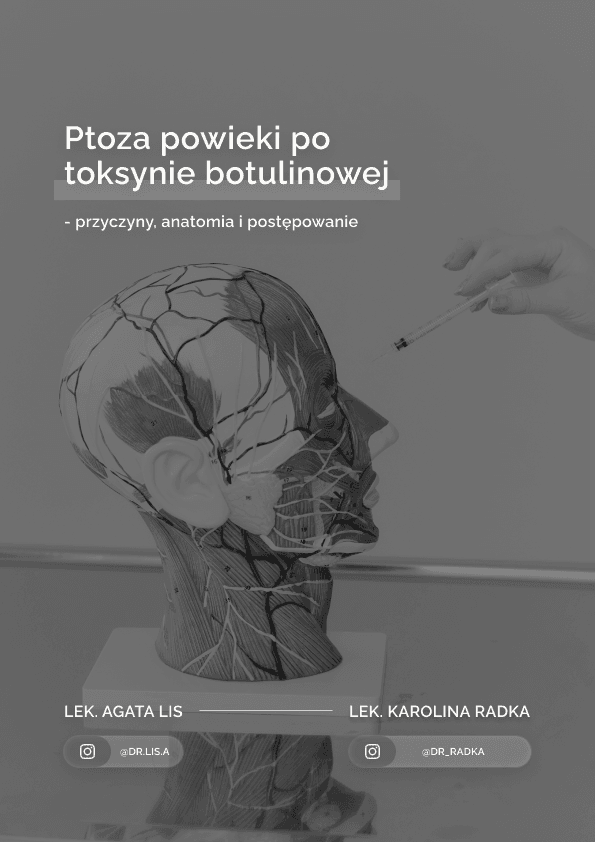
Sign up and get your free e-book: “Eyelid Ptosis After Botulinum Toxin – Causes, Anatomy, and Management”
Has a patient come back with a drooping eyelid? Find out why ptosis occurs, which anatomical structures are responsible, and what your management options are.
Knowing the injection points is often not enough. In this e-book, we explain how ptosis develops and cover the key information every doctor performing botulinum toxin treatments should know.
You may know the injection points, doses, and treatment protocol...
and yet eyelid ptosis can still occur. Why? Because treatment safety doesn't depend on injection technique alone.
Other factors matter just as much:
- the patient's individual anatomy
- the course of anatomical structures in the treatment area
- how the toxin diffuses through the tissues
- the interplay between the muscles of facial expression
Without understanding these mechanisms, it is much harder to understand why a complication occurred and how to manage it once it has.
Eyelid ptosis doesn't happen without a reason
Understanding how it develops is key not only to prevention but also to managing the complication once it occurs. In this e-book, we cover the key points every doctor working with botulinum toxin should know.
WHY EYELID PTOSIS OCCURS
You'll learn how ptosis develops and how the toxin can affect the structures responsible for lifting the eyelid.
THE ANATOMY THAT MATTERS
You'll understand the role of the levator palpebrae superioris, Müller's muscle, and the anatomical structures involved in this complication.
HOW TO RECOGNIZE AND ASSESS PTOSIS
You'll find out what to look for at the follow-up visit and which information matters most when assessing the patient.
MANAGEMENT OPTIONS
You'll discover the available treatment approaches, how they work, and the limitations worth keeping in mind in everyday practice.
Answer a few questions honestly
-
1. Would you know how to explain to a patient why they developed eyelid ptosis?
-
2. Can you identify which anatomical structures are responsible for lifting the eyelid?
-
3. Are you sure you understand how ptosis develops after botulinum toxin?
-
4. Do you know what management options are available once ptosis has occurred?
-
5. Can you tell why ptosis may occur in one patient but not in another?
-
6. Would you feel confident if a patient came back for a follow-up visit with a drooping eyelid?
If you answered “no” to even one question, this e-book is for you. 🤍
GET TO KNOW US
Who’s behind Aesthy?

I am a doctor and I work with aesthetic patients in my clinic every day. I also share my knowledge as a lecturer and coordinator of international postgraduate studies in aesthetic medicine for doctors at the Spanish AMIR Academy.
I have gained my clinical and teaching experience not only in Poland but also abroad – completing postgraduate studies in Spain, attending international congresses and training courses, observing how doctors practice in different countries, and working with lecturers from Spain, England, and Korea.
I am a practitioner, not a theorist – I spend every free moment looking for new techniques and the best solutions for my patients. When working with students, I focus on building solid foundations that allow them to make their own decisions and believe in their skills.

I am a doctor currently devoted entirely to aesthetic and regenerative medicine, both working with patients in my clinics and sharing my knowledge in training courses for doctors.
My passion for medicine has allowed me to grow in many areas. For over 3 years, I worked and trained in pathology, gaining experience in macroscopic and microscopic tissue diagnostics and taking part in autopsies, which gave me an in-depth understanding of the human body. I then decided to bring this experience to another specialty – aesthetic medicine, which completely captivated me with its complexity. I have deepened my knowledge by regularly attending numerous training courses and international congresses, including as a speaker (IMCAS Paris). I believe that curiosity and openness to the discoveries of doctors from all over the world are the key to truly understanding this vast field.
I have always enjoyed sharing knowledge, which is why I also worked as a university lecturer, teaching subjects including anatomy and pathology. Today, I pursue this passion by training doctors both online and in person. My goal is to share innovations and specialist findings from the world of aesthetic medicine with a wider audience, to show that this knowledge is accessible to everyone, not just a select few.